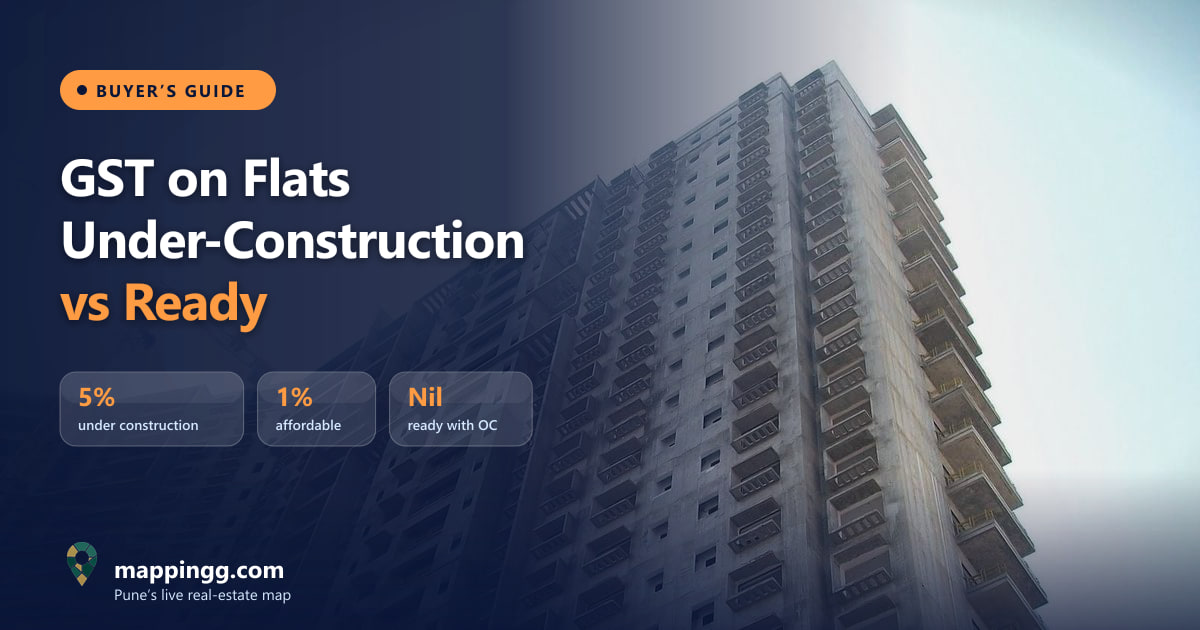
The price on a new project’s brochure often doesn’t include GST. Depending on the flat, it can add 5% to the price, just 1%, or nothing at all. This guide explains which rate applies to you, what “affordable housing” means for GST, and how GST works on parking, the clubhouse and maintenance.
The GST rates on homes
| What you buy | GST |
|---|---|
| Under-construction flat (not affordable housing) | 5%, without input tax credit |
| Under-construction flat that counts as affordable housing | 1%, without input tax credit |
| Ready-to-move flat, whole price paid after the completion / occupancy certificate | No GST |
| Resale flat bought from its owner | No GST |
| Under-construction office or shop | 12%, with input tax credit |
The 5% and 1% are effective rates: the law treats a third of the price as the value of the land, which isn’t taxed, and charges GST on the rest. You simply pay 5% (or 1%) of the agreement value.
“Without input tax credit” means the developer can’t claim back the GST it paid on cement, steel and contractors. That cost is part of the developer’s price, so you won’t see it as a separate line.
What counts as affordable housing for GST
A flat gets the 1% rate only if both of these are true:
- Carpet area of up to 60 sq m (about 645 sq ft) in the metro cities, or up to 90 sq m (about 968 sq ft) anywhere else; and
- The price (the gross amount charged) is ₹45 lakh or less.
For this rule, the metro cities are Bengaluru, Chennai, Delhi NCR (Delhi, Noida, Greater Noida, Ghaziabad, Gurugram and Faridabad), Hyderabad, Kolkata and Mumbai including the whole Mumbai Metropolitan Region, so Thane, Navi Mumbai, Kalyan and Dombivli use the 60 sq m limit. Pune is not on the list, so in Pune and Pimpri-Chinchwad a flat of up to 90 sq m carpet area qualifies, as long as the price is within ₹45 lakh.
The limit is on carpet area, the figure on the RERA registration and in the agreement, not the larger “super built-up” area in some brochures.
Examples
| Flat | Carpet area | Agreement value | Rate | GST |
|---|---|---|---|---|
| 1 BHK, Ravet | 420 sq ft | ₹38 lakh | 1% | ₹38,000 |
| 2 BHK, Wakad | 720 sq ft | ₹78 lakh | 5% (price over ₹45 lakh) | ₹3,90,000 |
| 3 BHK, Kharadi | 1,100 sq ft | ₹1.45 crore | 5% | ₹7,25,000 |
The same 1 BHK bought after the occupancy certificate, with the whole price paid then, would have no GST. That is one reason ready-to-move flats can cost less in total than the headline prices suggest. See ready-to-move vs under-construction flats.
When there is no GST
- Completed flats. GST doesn’t apply where the entire price is received after the competent authority issues the completion certificate or the occupancy certificate. Ask the developer for a copy of the certificate before you rely on this.
- Resale flats. Buying from an individual owner is a sale of property, not a supply by a business, so there is no GST. See our resale flat checklist.
- Land and plots on their own. Sale of land isn’t taxed under GST (development services that come with a plot can be).
If you booked during construction and the OC arrives before your last payments, how GST applies to the later instalments is something to confirm with the developer in writing, and to check in the agreement.
GST on parking, clubhouse and other charges
- Car parking, floor-rise and preferential location charges that are part of the price of the flat in the same agreement take the same rate as the flat (5% or 1%).
- Club membership, maintenance and other services charged separately are generally taxed at 18%.
- Advance maintenance collected by the developer at possession usually has 18% GST added. Monthly maintenance paid to your housing society has GST only above ₹7,500 a month (and ₹20 lakh a year for the society). See maintenance charges after possession.
- Stamp duty and registration are state charges, not GST, and are worked out separately. See stamp duty and registration charges in Pune.
How GST is collected
On an under-construction flat, the developer adds GST to each instalment as it falls due: with a construction-linked plan, at each slab or stage. Each demand letter should show the instalment and the GST on it separately, along with the developer’s GSTIN. Keep every receipt; together they show how much GST you paid in total.
GST on a home you buy to live in can’t be claimed back, and it isn’t part of the home-loan tax deductions. It does count as part of what you paid for the flat when you later work out capital gains on selling it.
Questions to ask before you book
- Is the quoted price “all inclusive”, or is GST extra?
- Which rate applies, 5% or 1%, and on what carpet area and price?
- Are parking and floor-rise charges in the same agreement as the flat?
- Which charges at possession (club, maintenance, legal) will have 18% GST?
- When is the occupancy certificate expected?
FAQs
Is GST charged on a ready-to-move flat?
Not if the whole price is paid after the completion or occupancy certificate has been issued.
Is there GST on a resale flat?
No. You pay stamp duty and registration, but not GST.
Is a ₹50 lakh, 600 sq ft flat in Pune “affordable” for GST?
No. The carpet area is within 90 sq m, but the price is above ₹45 lakh, so the rate is 5%.
Can the developer charge 12% or 18% on my flat?
Not on the flat itself; residential flats are at 5% or 1%. 18% applies to separate services such as maintenance or club membership.
This guide is general information based on the GST rates and rules as we understand them in October 2026, not tax advice. Rates can change through GST Council decisions. Check your cost sheet and agreement, and ask a chartered accountant about your own case.
Cover photo: Blueridge building under construction - panoramio by Deepak Patil, CC BY-SA 3.0, via Wikimedia Commons. Cropped, with text added.