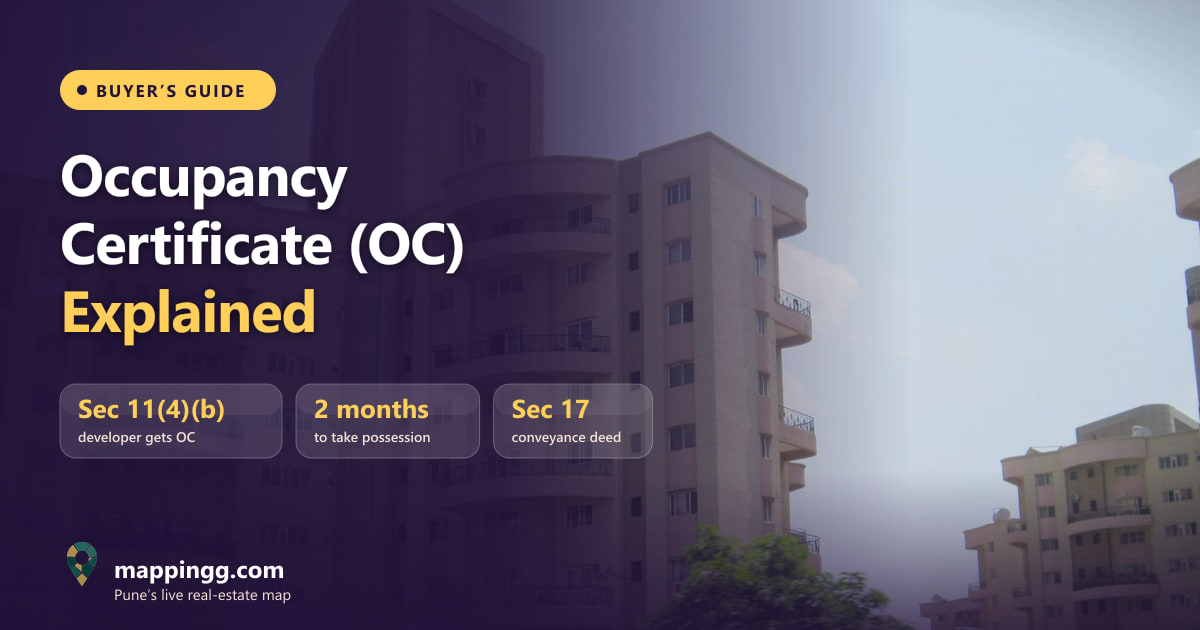
When an under-construction project is finished, the keys are only half the handover. The other half is the paperwork, and the most important document in it is the occupancy certificate, or OC. This guide explains what an OC is, how it differs from a completion certificate, and what to check before you take possession.
What is an occupancy certificate (OC)?
An OC is issued by the local planning authority (in the Pune region, usually the Pune Municipal Corporation, the Pimpri Chinchwad Municipal Corporation or PMRDA) after it inspects a finished building. It certifies that the building was built according to the sanctioned plans and is fit to be occupied, with provision for water, sanitation and electricity.
The RERA Act defines it in Section 2(zf) as the certificate, by whatever name called, issued by the competent authority permitting occupation of a building.
What is a completion certificate?
A completion certificate (defined in Section 2(q) of the RERA Act) certifies that the project has been developed according to the sanctioned plan, layout plan and specifications. Different authorities use different names and steps for it, and in many cities the completion and occupancy certificates are issued together or as one document.
Don’t confuse it with the commencement certificate, which is often also called a “CC” in Maharashtra. A commencement certificate is the permission to start construction, issued before work begins.
| Certificate | When it is issued | What it says |
|---|---|---|
| Commencement certificate | Before construction starts | The building plans are approved and work can begin |
| Completion certificate | When construction is finished | The project was built as per the sanctioned plans |
| Occupancy certificate (OC) | After inspection of the finished building | The building is fit to be lived in |
What RERA says
- The developer must get it (Section 11(4)(b)). The promoter is responsible for obtaining the completion certificate or the occupancy certificate, or both, and making it available to buyers individually or to their association.
- Conveyance follows the OC (Section 17). The developer must execute a registered conveyance deed in your favour and transfer the common areas to the association. Where no local law sets a period, the RERA Act sets a deadline of three months from the date of the OC. In Maharashtra, if a developer does not convey the land and building to the society, the society can apply for deemed conveyance.
- Buyers take possession after the OC (Section 19(10)). Every buyer must take physical possession of the flat within two months of the occupancy certificate being issued.
Why you should not move in without an OC
- The building has not been cleared as fit to live in. It may not match the approved plans, and the authority could act against unauthorised occupation.
- Utilities can be a problem. Permanent water and electricity connections are usually tied to the OC.
- Loans and resale get harder. Many banks ask for the OC before they lend on a resale flat, so a flat without one can be harder to sell later.
- Conveyance is held up. Without the OC, the society cannot get the land and building transferred to it.
If the possession date has passed and the developer is offering “fit-out possession” without an OC, read your rights when possession is delayed.
Part OC
Large projects in Pune are often built in phases, and the authority may issue a part occupancy certificate for some towers, wings or floors. If you are buying in such a project, check that the part OC covers your specific building and floor.
How to check the OC
- Ask the developer for a copy before you take possession, and keep it with your agreement and payment receipts.
- Check the details: the issuing authority, the date, the survey number, and the building, wing and floors it covers.
- Look at the project’s MahaRERA page, where developers upload their approvals and completion documents. Our guide shows how to find a project on MahaRERA.
- For a resale flat, ask the seller or the housing society for the OC before you pay a token amount.
The OC is one of several papers to check. See the full list of documents to check before buying a flat, or skip the wait by looking at ready-to-move projects.
FAQs
Can I take possession of a flat without an OC?
You shouldn’t. Under the RERA Act, possession follows the OC, and living in a building without one can cause problems with utilities, loans, resale and conveyance.
Who is responsible for getting the OC?
The developer. Section 11(4)(b) of the RERA Act makes the promoter responsible for obtaining it and making it available to buyers.
Is a completion certificate the same as an OC?
Not exactly. A completion certificate says the project was built as per the sanctioned plans; an OC says the building is fit to occupy. Some authorities issue them together.
What is a part OC?
An occupancy certificate for only some towers, wings or floors of a project. Check that it covers your flat.
This guide is general information, not legal advice. Rules and procedures differ between authorities and change over time. Have the documents checked by a property lawyer and verify project details on the official MahaRERA website.
Cover photo: Magarpatta Residential Apartments (2) by Samreenshaikh, CC BY-SA 3.0, via Wikimedia Commons. Cropped, with text added.