When you budget for a flat in Pune, the price on the brochure is only the start. On top of it you pay stamp duty, a registration fee, GST if the flat is under construction, and several smaller charges. Together they can add more than 10% to the cost. This guide explains each one, with a worked example, so there are no surprises on the day you register.
Stamp duty in Pune (2026)
Stamp duty is a state tax on the property document. Within Pune Municipal Corporation (PMC) and Pimpri-Chinchwad Municipal Corporation (PCMC) limits, it is made up of three parts:
| Component | Men / joint with a man | Woman (sole owner) |
|---|---|---|
| Stamp duty | 5% | 4% |
| Metro cess | 1% | 1% |
| Local body tax (LBT) surcharge | 1% | 1% |
| Total | 7% | 6% |
Three things to know:
- It is charged on the higher value. Stamp duty is worked out on the agreement value or the government’s ready reckoner value for that flat, whichever is higher.
- The women’s concession applies to residential property bought in a woman’s name. Check the current conditions before you register, especially for joint ownership.
- Outside city limits it is lower. In gram panchayat areas around Pune, the metro cess and LBT surcharge generally don’t apply.
Registration fee
The registration fee is 1% of the property value, capped at ₹30,000. For almost every new flat in Pune city, you’ll pay the full ₹30,000. You pay it when the agreement for sale is registered at the sub-registrar’s office.
GST on under-construction flats
| Type of flat | GST |
|---|---|
| Ready-to-move, with occupancy certificate (OC) | None |
| Under construction, affordable (up to ₹45 Lacs and up to 90 sq m carpet in Pune) | 1% |
| Under construction, all others | 5% |
GST is charged without input tax credit and is normally collected with each construction-linked instalment. Ask the developer whether the quoted price includes GST. Parking, club membership and other charges billed by the developer may attract GST separately.
Worked example: an ₹80 Lacs flat in Pune city
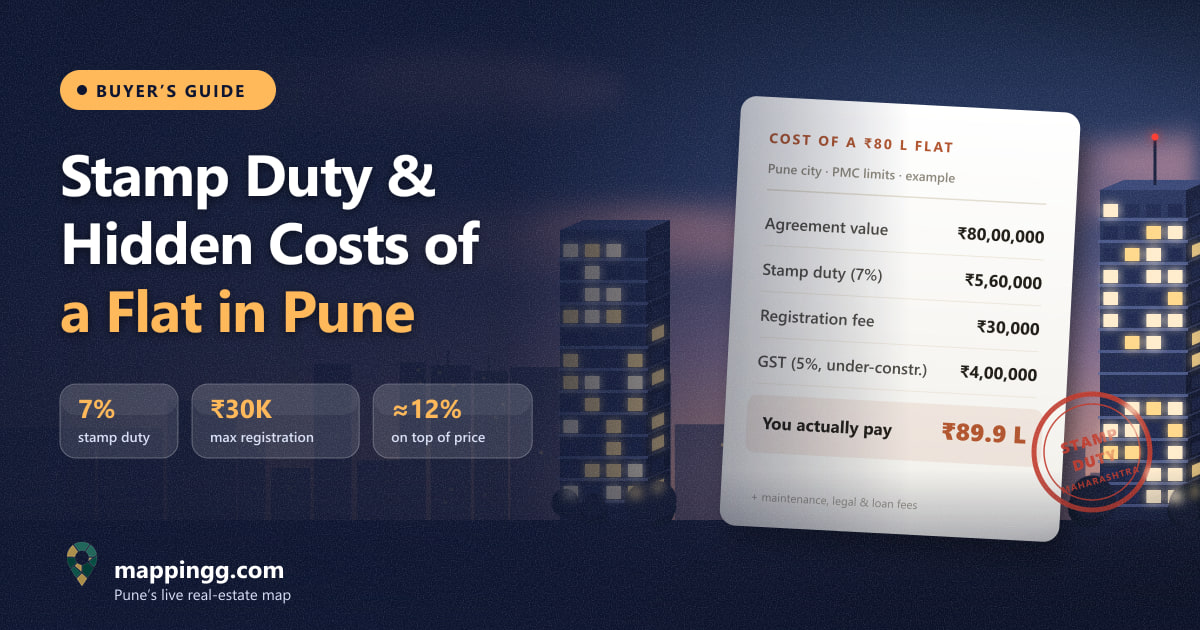
Take a 2 BHK in PMC limits with an agreement value of ₹80 Lacs, bought under construction by a man (or jointly with a man):
| Item | Amount |
|---|---|
| Agreement value | ₹80,00,000 |
| Stamp duty, metro cess & LBT (7%) | ₹5,60,000 |
| Registration fee (capped) | ₹30,000 |
| GST (5%) | ₹4,00,000 |
| Total before other charges | ₹89,90,000 |
If the flat is registered in a woman’s name alone, stamp duty falls to 6% (₹4,80,000), saving ₹80,000. If the same flat is ready to move with an OC, there is no GST, saving ₹4 Lacs.
TDS: 1% you deduct, not an extra cost
If the flat costs ₹50 Lacs or more, you must deduct 1% TDS from each payment to the developer and deposit it with the Income Tax Department under the developer’s PAN. It isn’t an extra cost, because the developer gets credit for it, but forgetting it can lead to interest and penalties. On an ₹80 Lacs flat, the TDS is ₹80,000.
The smaller costs buyers forget
- Maintenance deposit: developers usually collect 12 to 24 months of maintenance in advance at possession.
- Society formation and legal charges: often a fixed amount, collected at possession.
- Electricity and water connections: meter and connection deposits.
- Parking, floor rise and preferential location charges (PLC): check whether they are in the quoted price.
- Home loan costs: processing fees, legal and valuation charges, and stamp duty on the loan agreement.
- Brokerage, if you buy through a broker.
- Interiors and furnishing, which many buyers leave out of the budget entirely.
How to keep the extra costs down
- Ask for an all-inclusive cost sheet that shows the agreement value, GST, stamp duty, registration and every other charge before you pay the booking amount.
- Consider registering in a woman’s name where it suits your family, to save 1% stamp duty.
- Compare ready-to-move flats, which carry no GST. Our guide to ready-to-move vs under-construction flats explains when that makes sense.
- Keep a buffer of 12–15% of the price for an under-construction flat in Pune city, or 7–10% for a ready one.
Looking for homes that leave room in the budget? See our list of flats under ₹1 crore in Pune, and always check the MahaRERA number before you book.
FAQs
What is the stamp duty in Pune in 2026?
Within PMC and PCMC limits, it is 7% (5% stamp duty, 1% metro cess and 1% LBT surcharge). Women buying in their own name pay 6%.
What are the registration charges in Pune?
1% of the property value, capped at ₹30,000.
Is stamp duty charged on the agreement value or the ready reckoner rate?
On whichever is higher of the two.
Can I include stamp duty in my home loan?
Banks generally lend against the property value and don’t fund stamp duty and registration, so plan to pay them from your own savings.
Rates are as reported for October 2026 and can change. This guide is general information, not legal or tax advice. Confirm the current rates on the IGR Maharashtra website or with a property lawyer before you register.