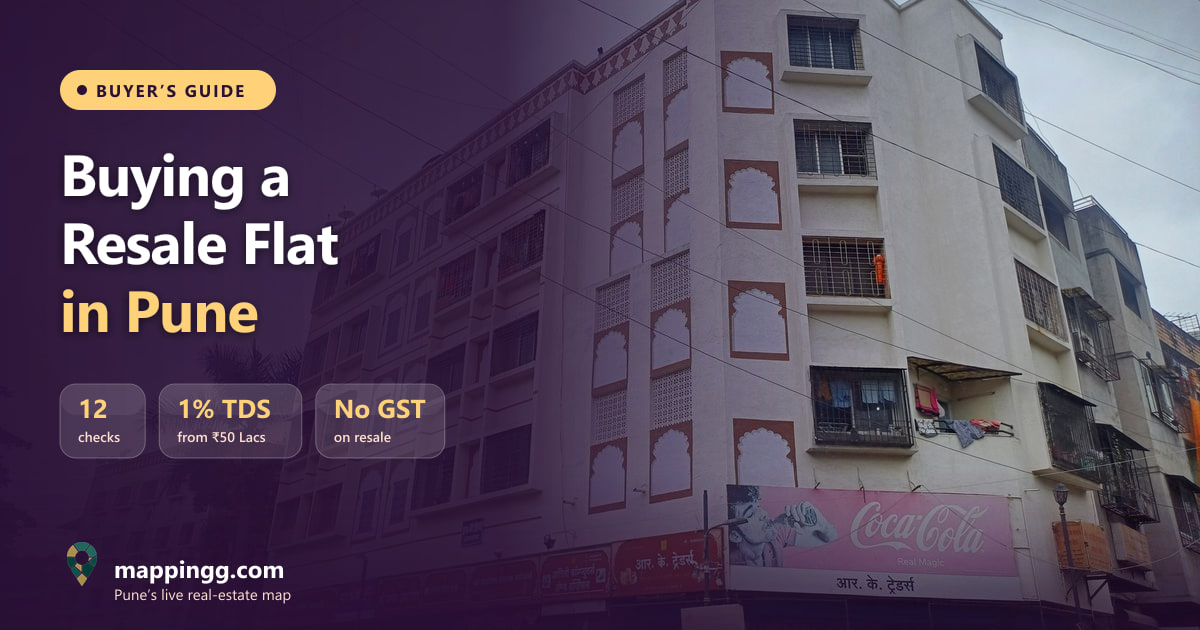
A resale flat has real advantages. You can see the flat, the building and the neighbours before you buy, you can move in straight away, and there is no GST. But there is no RERA registration to check and no developer to hold to a promise, so the checks you do yourself matter more. This guide lists the documents and checks before you pay a token, and the steps to transfer the flat into your name.
Resale vs new: what is different
- No GST on a completed flat, unlike an under-construction one. See ready-to-move vs under-construction flats.
- Stamp duty and registration are the same as for a new flat, on the agreement value or the ready reckoner rate, whichever is higher. See stamp duty and registration charges in Pune.
- RERA usually doesn’t apply to a sale between two owners, so your protection is in the documents and the agreement.
- The housing society has to accept you as a member, so it becomes part of the deal.
Documents to ask the seller for
- The chain of agreements. Every agreement from the builder’s original sale to the seller, registered, with the stamp duty paid. A gap in the chain is a red flag.
- Index II for the seller’s purchase, which shows the registration at the sub-registrar’s office.
- The share certificate issued by the housing society in the seller’s name, which shows they are a member.
- A no-objection certificate (NOC) from the society for the sale, and a statement that there are no dues.
- The occupancy certificate (OC) for the building. Without it, the building may not be legal to live in, and banks may not lend. See our OC and CC guide.
- Paid bills: the latest property tax, electricity and maintenance receipts, so you don’t inherit dues.
- Loan papers, if the flat is mortgaged: a letter from the seller’s bank stating the amount outstanding, and, after it is paid off, a loan closure letter and the original documents returned by the bank.
Our list of documents to check before buying a flat covers the building-level documents in more detail.
Checks to do yourself
- A title search. Get a lawyer to search the sub-registrar’s records for at least 30 years and give a title report. It shows any other sale, mortgage or claim on the flat.
- Check who owns it. If the flat is jointly owned or inherited, every owner, or every legal heir, has to sign. For an inherited flat, ask for the death certificate and the will, probate or heirship documents.
- Check the area. Measure the carpet area and compare it with the agreement. Older agreements often show built-up or super built-up area; see carpet vs built-up vs super built-up area.
- Check the building. Look for cracks, leaks and damp, the condition of the lifts, the water supply and the parking. Ask whether a structural audit has been done if the building is older. Our site visit checklist lists what to look at.
- Check for changes. An enclosed balcony, a merged terrace or a moved wall may not be in the approved plan, and the society or the municipal corporation can ask for it to be undone.
The money: token, TDS and loans
- Keep the token small and pay it against a written receipt that states the price, the flat and the date for the agreement, and what happens to the token if the deal falls through.
- TDS. If the price is ₹50 lakh or more and the seller is resident in India, you must deduct 1% TDS from the payment and deposit it with the government (Form 26QB). If the seller is a non-resident, the TDS rate is much higher; ask a chartered accountant.
- Home loans. Banks value the flat themselves and may lend less than the price on an older building, or for a shorter term. Get your loan approved before you sign. See home loan EMI and eligibility.
- Pay by bank transfer only, to the seller’s account, and to their bank if there is a loan outstanding.
Transferring the flat
- Sign and register the agreement for sale at the sub-registrar’s office, with stamp duty paid. Both sides and two witnesses attend.
- Apply to the society for membership and the transfer of the share certificate. The society can charge a transfer premium, but it is capped by state rules, so ask for it in writing.
- Transfer the property tax and the electricity connection to your name.
- Keep the originals of every document, including the full chain of earlier agreements, safely.
FAQs
Is GST payable on a resale flat?
No. GST applies only to under-construction flats bought from a developer.
Is stamp duty lower on a resale flat?
No, it is worked out the same way as for a new flat in Maharashtra.
Can I buy a resale flat in a building without an OC?
It is risky. Banks may not lend, and the building may face action. Ask a lawyer before you go ahead.
Who pays the society transfer charges?
It depends on what the buyer and seller agree. Write it into the agreement.
This guide is general information, not legal or tax advice. Rules change over time. Have the documents checked by a property lawyer before you pay, and confirm TDS and tax questions with a chartered accountant.
Cover photo: Ganesh Apartment, Kasba Peth, Pune by DesiBoy101, CC BY 4.0, via Wikimedia Commons. Cropped, with text added.