When you buy an under-construction flat, you don’t pay the full price on day one. You pay in parts, according to a payment plan. The plan you choose decides how much of your money the developer holds before the flat is ready, how soon your home loan EMIs start, and how much risk you carry if the project is delayed. This guide explains the common plans and what to check before each payment.
What RERA says about payments
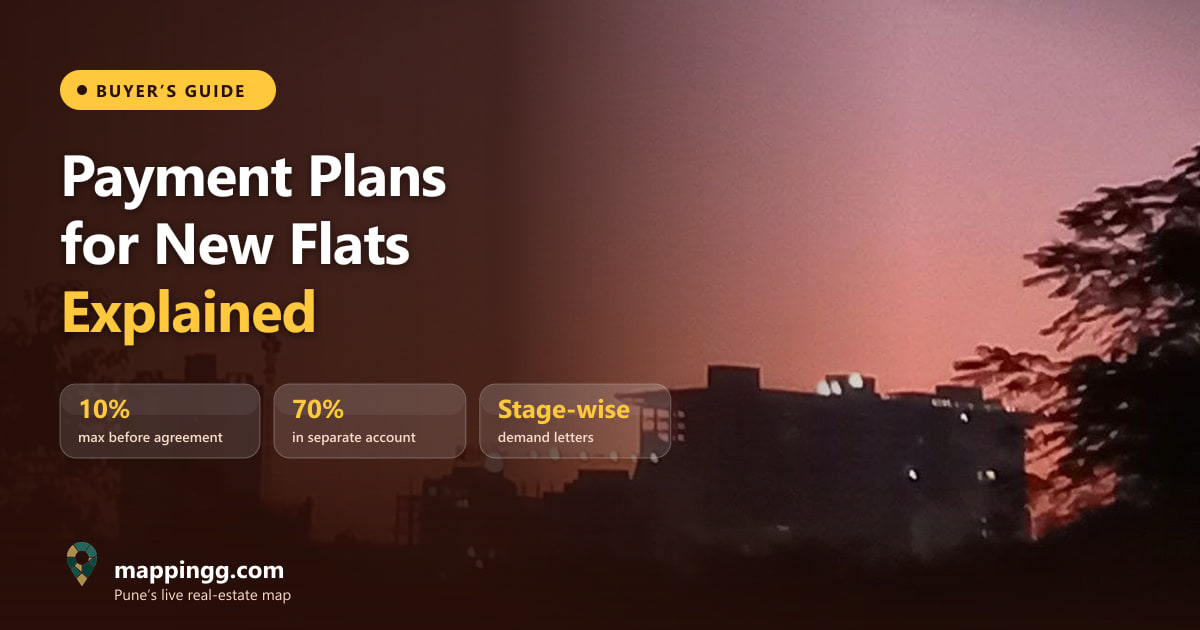
- No more than 10% before the agreement. Under Section 13 of the RERA Act, a developer cannot take more than 10% of the cost as an advance before a registered agreement for sale. See clauses to check in the agreement for sale.
- The schedule goes in the agreement. The dates and manner of payment must be written in the agreement.
- 70% goes into a separate account. Under Section 4(2)(l)(D), developers must deposit 70% of the money collected from buyers in a separate bank account, to be used only for the cost of land and construction of that project. Withdrawals have to be in proportion to the work completed, certified by an engineer, an architect and a chartered accountant.
- Interest works both ways. If you pay late, the developer can charge interest; if the developer delivers late, it pays you interest at the same rate.
The common payment plans
| Plan | How you pay | Good for | Main risk |
|---|---|---|---|
| Construction-linked (CLP) | In stages as the building goes up | Most buyers | Small; you pay as work is done |
| Down payment | Most of the price soon after booking | Buyers with cash who want a discount | Your money is stuck if the project stalls |
| Flexi | A larger first payment, then stages | Buyers who want some discount with less risk | Partly the same as down payment |
| Subvention (e.g. 20:80) | A small part upfront; the bank pays the rest to the developer | Buyers paying rent who can’t afford EMI + rent | You owe the bank even if the developer defaults |
1. Construction-linked plan (CLP)
This is the most common plan. After the booking amount and a payment on signing the agreement, each further payment is due when a stage of construction is complete: the plinth, each slab, the walls and plaster, the plumbing and lifts, and finally possession. If work slows down, your payments slow down too. The MahaRERA model agreement follows this approach.
2. Down payment plan
You pay most of the price, often 90% or more, soon after the agreement, usually in return for a discount. The saving can be real, but so is the risk: if the project is delayed or stalls, most of your money is already with the developer. Consider it only with an established developer whose project is well under way.
3. Flexi plan
A middle path: you pay a larger share upfront than in a CLP, for a smaller discount, and the rest is linked to construction.
4. Subvention plans (20:80, 10:90)
You pay a small part of the price, and the bank disburses most of the loan to the developer early. The developer agrees to pay the interest on your loan (the pre-EMI) until possession, so you pay nothing more until then.
The catch: the loan is in your name. If the developer stops paying the interest or the project is delayed, the bank will ask you to pay, even if your flat is not ready. Regulators have cautioned lenders about these schemes in the past. If you take one, read the tripartite agreement between you, the developer and the bank carefully, and know what happens if the developer stops paying.
Home loans during construction
With a construction-linked plan, the bank releases your loan in parts as each demand letter comes in. Until the full loan is disbursed you can choose to pay:
- Pre-EMI: interest only on the amount released so far. It is lower now, but you have not started paying off the loan.
- Full EMI: the normal EMI from the start, which reduces the loan sooner and the total interest you pay.
Our guide to home loan EMI and eligibility shows how much you can borrow and what the EMI will be.
How to check a demand letter
- Match the stage. The letter should name a stage in your agreement’s payment schedule, such as “completion of the 8th slab”.
- Check the progress. Compare it with the project’s latest progress update on MahaRERA, and, if you can, with what you see on site. Our guide shows how to find a project on MahaRERA.
- Check the amount. It should be the agreed percentage of the agreement value, plus GST. Under-construction flats attract 5% GST (1% for affordable housing) on each instalment; see ready-to-move vs under-construction flats.
- Pay to the right account. Pay only to the bank account named in the agreement or the demand letter on the developer’s letterhead, never in cash, and keep every receipt.
FAQs
Which payment plan is safest?
A construction-linked plan, because your payments follow the actual progress of the building.
Is a down payment discount worth it?
Only if you trust the developer to deliver on time. Compare the discount with the interest you would earn on the money, and with the risk of a delay.
Can a developer ask for payment before the stage is complete?
Under a construction-linked plan, a payment is due only when the stage in the agreement is complete. If the progress on MahaRERA or on site does not match, ask the developer for proof before you pay.
Who pays the interest if a subvention developer defaults?
You do. The loan is in your name, so the bank can ask you to pay even though the developer had agreed to.
This guide is general information, not legal or financial advice. Check the terms with your bank and a property lawyer, and verify project details on the official MahaRERA website before you pay.
Cover photo: South Pune Skyline by FlyingBlock, CC BY-SA 4.0, via Wikimedia Commons. Cropped, with text added.