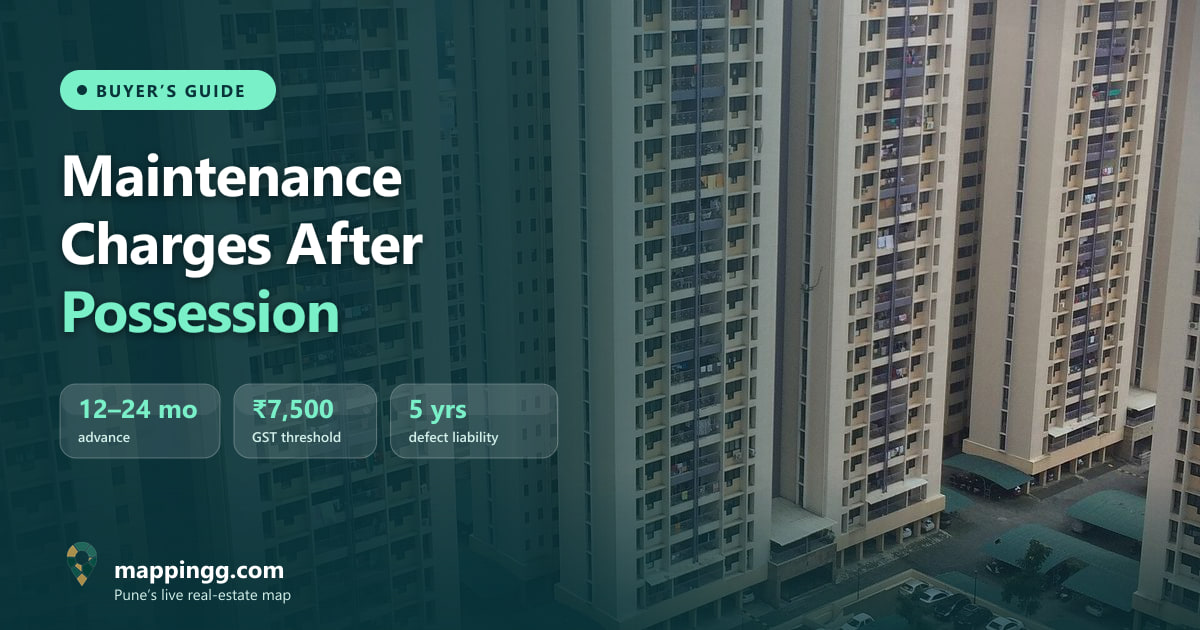
When you take possession of a new flat, the developer’s demand letter usually has a second page: advance maintenance, society charges, deposits and more. After that comes a monthly maintenance bill for as long as you own the flat. This guide explains what each charge is for, how monthly maintenance is worked out, when GST applies, and how the developer hands the building over to the housing society.
What you pay at possession
| Charge | What it is for |
|---|---|
| Advance maintenance | Usually 12 to 24 months of maintenance, used to run the building until the society takes over |
| Society formation and legal charges | Registering the housing society and its documents |
| Share money and entrance fee | Your membership of the society; small amounts |
| Corpus or sinking fund deposit | A one-time amount kept for major repairs in future years |
| Electricity and water connection deposits | Meters and connections, often paid through the developer |
| Club membership | The clubhouse, if it was not included in the price |
All of these should be in the agreement for sale or the cost sheet you got at booking. If a charge appears at possession that isn’t in either, ask for the clause that allows it. Our guide to stamp duty and hidden costs covers the costs at booking and registration.
When maintenance starts
Until possession is offered, the developer pays for running the building. Once the developer has the occupancy certificate and offers you possession, the agreement usually says you pay maintenance from that date, often after a short notice period, whether or not you move in. Delaying possession to avoid maintenance doesn’t work.
How monthly maintenance is worked out
New projects in Pune usually charge maintenance at a rate per square foot of area each month, so a bigger flat pays more. Under the Maharashtra model bye-laws that most housing societies adopt, some costs (such as staff and common services) are shared equally per flat, while others (such as the sinking fund) are shared by area. Ask which area the rate is on: carpet area or a larger figure. See carpet vs built-up vs super built-up area.
Example: at ₹4 per sq ft a month on an 800 sq ft flat, maintenance is ₹3,200 a month, and 24 months in advance is ₹76,800 (plus GST if it applies). Projects with large clubhouses, pools and many lifts cost more to run, so look at the expected maintenance as well as the price when you compare projects.
Monthly maintenance typically pays for security, housekeeping, lifts, generators and pumps (running and annual contracts), common-area electricity, the water supply, the sewage treatment plant, garden upkeep, insurance and the society’s office costs.
Sinking fund and repair fund
The Maharashtra model bye-laws require a society to put money aside every year for the building’s future:
- Sinking fund: at least 0.25% of the construction cost of each flat every year, kept for major repairs or rebuilding.
- Repairs and maintenance fund: about 0.75% of the construction cost of each flat a year, for regular repairs.
These are part of your maintenance bill. A healthy sinking fund means that a big repair, such as waterproofing the terrace or replacing lifts, doesn’t need a large one-off demand from every member.
GST on maintenance
GST at 18% applies to maintenance only when both of these are true:
- The society’s total collections are more than ₹20 lakh a year, and
- Your contribution is more than ₹7,500 a month.
If your bill is more than ₹7,500, GST is charged on the whole amount, not just the part above ₹7,500. Most flats in Pune pay less than that, so most owners don’t pay GST on monthly maintenance. Advance maintenance collected by the developer before handover is different: developers usually charge GST on it, so check the demand letter.
Property tax
Property tax is separate from maintenance. The Pune Municipal Corporation (PMC) or Pimpri-Chinchwad Municipal Corporation (PCMC) assesses each flat after the occupancy certificate and sends the bill to the owner. PMC gives a concession on property tax for a home the owner lives in; apply for it with the form PMC asks for, as it isn’t always applied automatically. Some societies collect property tax with the maintenance bill and pay it on members’ behalf.
If you rent the flat out
Societies in Maharashtra can charge non-occupancy charges on flats that are rented out, but these are capped at 10% of the service charges (not counting municipal taxes). A society can’t charge you more than that just because you don’t live there. If you sell, the society can charge a transfer premium, which state rules cap at ₹25,000.
Society formation and handover
Under MahaRERA rules, the developer has to apply to register the housing society within three months of the date when 51% of the flats have been booked. After the building is complete, the developer must transfer the building and the land (the conveyance) to the society within the time set in the agreement and the rules. If the developer doesn’t, the society can apply to the District Deputy Registrar of co-operative societies for deemed conveyance.
At handover, the society should get from the developer:
- The money: the unspent advance maintenance, the corpus or sinking fund deposits and any other deposits collected from members, with audited accounts.
- The documents: approved and as-built plans, the commencement and occupancy certificates, fire and lift approvals, and the conveyance papers.
- Warranties and contracts: for lifts, generators, pumps, the sewage treatment plant and fire systems, so the society knows when they expire.
Defects after possession
Under RERA, if you find a structural defect or a defect in workmanship, quality or services within five years of possession, the developer has to fix it within 30 days of being told, at no cost. Report defects in writing and keep a copy. If the developer doesn’t act, you can complain to MahaRERA. See our guide to RERA rights and MahaRERA complaints.
Before you book: questions to ask
- What will monthly maintenance be, per sq ft and on which area?
- How many months of advance maintenance will you collect, and is GST extra?
- Is there a corpus or sinking fund deposit, and how much?
- Is club membership included in the price?
- When will the society be formed, and when will the conveyance be done?
FAQs
Do I have to pay maintenance if my flat is empty?
Yes. Maintenance is due from the date possession is offered, whether or not you live there.
Is GST charged on society maintenance?
Only if the society collects more than ₹20 lakh a year and your bill is more than ₹7,500 a month. Then it is 18% on the whole bill.
What happens to the advance maintenance I paid the developer?
The developer uses it to run the building until handover, and must pass the unspent balance, with accounts, to the society.
Who decides the maintenance amount after handover?
The society’s managing committee and general body, under its bye-laws.
This guide is general information based on the rules as we understand them in October 2026, not legal advice. Your agreement for sale and your society’s bye-laws set the details. Check them, and ask a property lawyer about any dispute.
Cover photo: Asawari Apartments,Nanded City by Akshit 77, CC BY-SA 4.0, via Wikimedia Commons. Cropped, with text added.